

Written by: Ismail Einashe and Geesje van Haren
Lost in Europe is a cross-border journalism project that investigates the disappearance of child migrants in Europe. Our investigation was prompted by a comment made by a former Europol chief of staff in 2016. Who had said that no fewer than 10,000 migrant children have gone missing in Europe.
These children are feared to have fallen into the hands of drug gangs, forced begging, human traffickers, or were sold into the sex industry. While others may have travelled to family or friends in Europe without reporting it. Some have all but disappeared.
The plight of child migrants in Europe is one of the most pressing issues in the so-called migrant crisis. The goal of Lost in Europe is therefore to recover the stories of these missing children. It comprises a team of 24 investigative journalists from 10 European countries, including the Netherlands, Belgium, Italy and the UK and we are collaborating to find out what has happened to these disappeared children in Europe.
We deal with incomplete data, authorities that do not want to help and with extremely vulnerable sources. That is the ongoing challenge in our project. We interview children in close quarters, social workers who are not allowed to talk to us because of their jobs, and we analyse incomplete statistics that often get us nowhere. These challenging factors require innovative journalistic working methods.
The Lost in Europe project began in the summer of 2018 after we won the inaugural Investigative Journalism for the EU fund. Since then, we have uncovered a number of important findings. In April our latest investigation found that at least 18,000 unaccompanied child migrants have disappeared after arriving in Europe between 2018 and 2020 — raising serious questions about the extent European countries are able or willing to protect unaccompanied child migrants.
In 2019 we revealed that 60 Vietnamese children had escaped Dutch shelters to be trafficked into Britain with authorities suspecting that most of the children had ended up working on cannabis farms and nail salons. For this investigation in April, we won the inaugural Investigative Journalism for the EU Impact Award 2021. The jury said: “Lost in Europe shone an important light on the terrible story of missing migrant children.”
We came together back in 2018 because we felt as journalists the plight of missing child migrants in Europe was not getting enough coverage. In fact, we felt the coverage on them was patchy, indifferent and insensitive. The issues these children experience is also compounded by the fact they are outside the European asylum system and do not receive adequate protection.
We decided to team up to get answers. We felt us working as lone journalists in the UK, Netherlands or Italy was not enough – since these migratory movements were cross-border and transnational. We decided that as journalists we needed to reframe the way we work, and move beyond our own national bubbles, into a pan-European and cross-border form of journalism.
In particular we decided we would focus on unaccompanied minors who had gone missing. Our focus was also on the gaps within the asylum system through which these children disappear and the mechanisms by which they remain outside this system.
In our work we are not only seeking to recover the stories of missing child migrants, but we are also interested in the asylum and migration system and how it actually works. We investigate what happens to child migrants at European borders such as the French and Italian border or with police, the immigration system — and we investigate whether these systems are fair, transparent or adhere to fundamental human rights enshrined under EU and national laws.
We also delve into how officials themselves behave and ask whether they actually live up to these laws? What we have found is that in many cases the system itself is a key part of the problem. For example, we often ask children about what their experiences of the system or with police and the stories from them are usually harrowing.
Collaboration and Mutual Exchange – New Modes of Investigative Journalism
Over the years what we have learned investigating these stories is that in order to put the spotlight on the plight of missing child migrants in Europe, we as journalists need to work in a different way. We need to work in a way that is cross-border, collaborative, about mutual exchange and is cross-sectoral. We also need a new way of doing journalistic collaboration that rattles everyday hierarchies that define the media landscape in Europe.
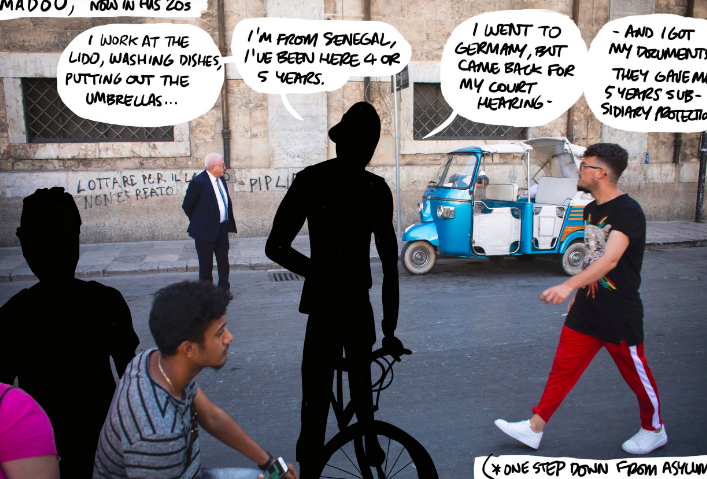
For example, we have collaborated with Cuban artist Tania Bruguera at the Tate Modern, photographer Kate Stanworth and graphic journalist Dan Archer to reimagine how we tell migrant stories. We have learned that we get the best work done, when we work within a multidisciplinary team, using non-linear and creative working methods. In this space different disciplines, backgrounds, working methods and perspectives come together to the benefit of our work.
In Lost in Europe, we are committed to doing this work in a diverse, and trauma-aware manner. For example, we feel that diversity in the media should not be a gimmick or an administrative afterthought. But should be at the very heart of any journalism initiative. We feel that if we want to create new ways of doing journalism, then we should not recreate the old media order in Europe that does not work because it is the preserve of distant elites – we need a media that is truly cross-border, collaborative, diverse and a media that reflects all of us.
Our hope is that the work we are doing in Lost in Europe can in a small way go towards an improved media engagement on stories of migration in Europe and shine a light on the experiences of vulnerable child migrants in the continent. So that no one can say anymore, that… we don’t see them.
Ismail Einashe is an award-winning journalist and writer based between Nairobi and London who has written for The Guardian, The Sunday Times, BBC News, ArtReview, Frieze, Foreign Policy, among many others. At present, he is a Senior Journalist at Lost in Europe, a cross-border journalism project, which investigates the disappearance of child migrants in Europe. Ismail has co-edited the book, Lost in Media: Migrant Perspectives and the Public Sphere , a collection of essays on the representations of migrants and refugees in the European media. Ismail is also a member of the editorial board of the Tate Etc. the magazine of the Tate Galleries.
Geesje van Haren has run her own media organization VersPers for over 15 years. Geesje is the driving force of the Lost in Europe project and leads a growing team of journalists in Europe. She coordinates the research on the ground, brings the team together, works in the field and is responsible for fundraising. Geesje also has extensive experience as a media producer in the Netherlands and she teaches investigative journalism, entrepreneurship and photography. She is also founder of the private school for investigative journalism Open Eyes Amsterdam.